
The Weight of the Interview
A disability evaluation interview is not a routine intake call. For the person on the other end of the line, it often represents months of waiting — for recognition, for support, for a decision that will shape whether they can pay rent, access care, or return to work. The stakes are personal and immediate. The questions are probing. The process is exhausting.
For the organisation conducting the interview, the stakes are different but no less significant. Every response must be captured accurately. Inconsistencies must be flagged. Clinical thresholds must be documented with precision that will survive legal scrutiny. And this must happen at scale — dozens, sometimes hundreds of evaluations per week — each one unique, none of them routine.
The traditional answer to this challenge has been skilled human interviewers: trained, empathetic, experienced. That answer has also been expensive, inconsistent, and increasingly difficult to staff. The average tenure of a disability intake coordinator is under 18 months. The institutional knowledge they carry walks out the door with them. The question the sector is now confronting is whether AI can carry some of that burden — not by replacing human judgment, but by creating the structured foundation on which good human judgment can operate.
What Makes Disability Evaluations Different
Disability evaluations occupy a distinct and demanding position in the intake landscape. Unlike a standard insurance claim or IME referral, a disability evaluation interview must capture not just demographic and administrative data, but functional history — what the person can and cannot do, how their condition manifests day to day, where the boundaries of their capacity lie. This is qualitative, contextual, and often contested.
The interview must also navigate significant variation in respondent circumstance. Some claimants have strong recall and can articulate their limitations clearly. Others are in pain, cognitively fatigued, dealing with secondary mental health conditions, or navigating language barriers. The interview protocol must adapt — not skip — in response to these variations. A static script fails here. A generic AI assistant fails here. What is required is a system that understands the structure of a disability evaluation, can probe adaptively when responses are incomplete, and can capture nuance without projecting.
There is also the legal dimension. Disability evaluation records are frequently subpoenaed, reviewed by tribunals, and scrutinised by legal counsel on both sides of a dispute. Every answer recorded must be attributable, timestamped, and defensible. Gaps in the record are not neutral — they are evidence of process failure, and they generate adverse inferences. The administrative quality of the intake record is, in many cases, as consequential as the clinical content.
How Voice AI Conducts a Structured Evaluation Interview
Voice AI disability evaluation interviews operate on a fundamentally different model than scripted IVR or generic chatbot intake. The system begins from a structured evaluation protocol — specific to the disability type, jurisdiction, and referral source requirements — and executes it as an adaptive voice conversation rather than a linear script.
When a claimant responds to a question about their mobility limitations, the AI does not simply record the response and advance to the next question. It evaluates completeness against the required clinical fields. If the response references a condition not yet documented in the file, it follows up. If the claimant indicates uncertainty or distress, it acknowledges and re-paces. If a response is inconsistent with earlier information — a claimant who reported severe back pain but mentions gardening as a daily activity — the system flags the discrepancy for clinical review without confronting the claimant directly.
Throughout the interview, every exchange is transcribed in real time, structured into named clinical fields, and written to the evaluation record. When the interview concludes, the case file contains a complete, structured intake record — not a transcript that requires a human to parse and re-enter, but a clean data object ready for clinical review, report generation, and system integration. The average AI-conducted disability evaluation captures 40% more structured data points than a manually conducted interview of equivalent duration.
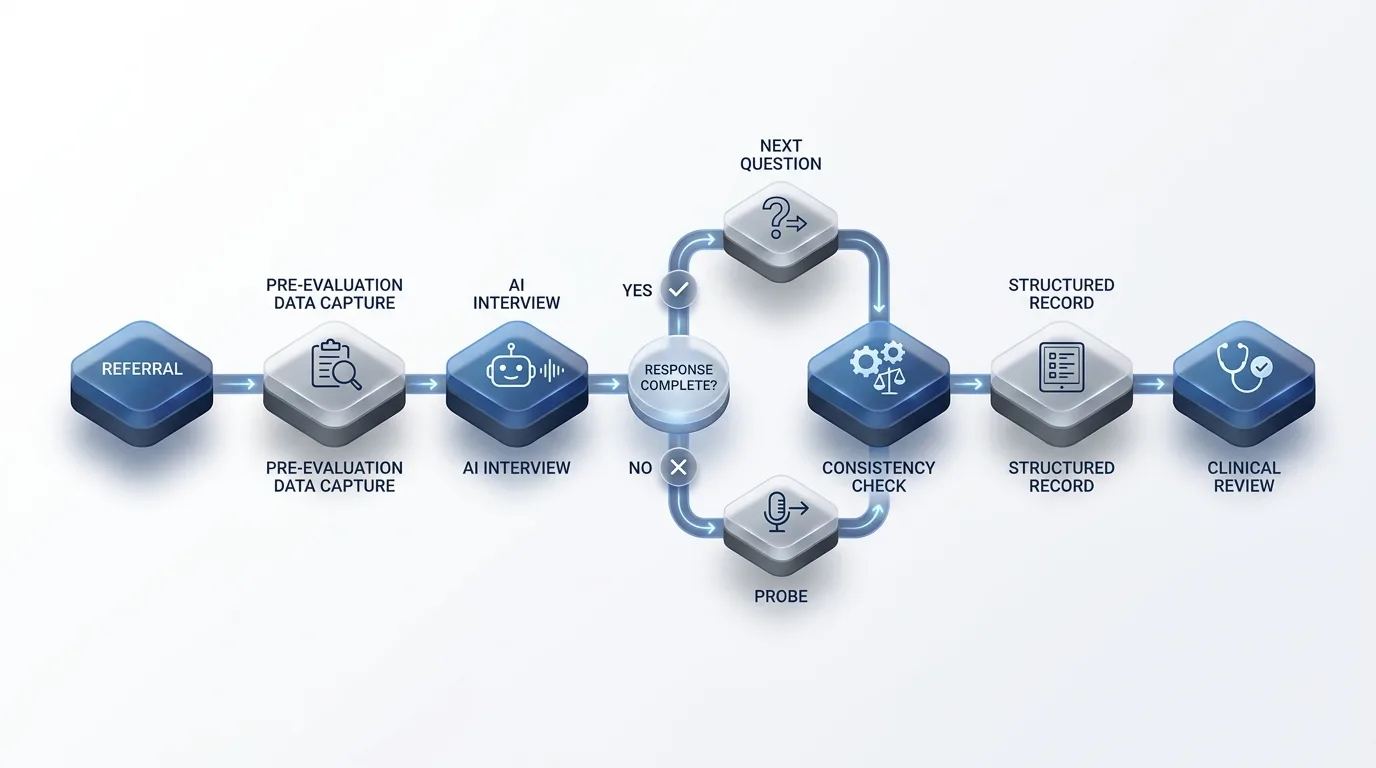
Technical schematic
Fig 1.1: The AI-assisted disability evaluation workflow. Adaptive questioning logic adjusts in real time to claimant responses — probing incomplete fields, flagging inconsistencies, and capturing structured clinical data throughout. Human reviewers receive a complete record, not a raw transcript.
The Consistency Advantage: What Humans Cannot Replicate at Scale
Human interviewers are good. On their best day, with a cooperative claimant, a well-rested coordinator can conduct an excellent disability evaluation interview. The problem is that excellence is not consistent. The tenth interview of the day is different from the first. A coordinator who has handled three difficult calls before noon will bring different energy to the fourth. A new hire conducting their first solo evaluation will miss things a veteran would catch.
AI does not have bad days. The fifty-third interview of the day is structurally identical to the first. Every required field is probed. Every inconsistency is flagged. Every accommodation — language preference, response pacing, reading level — is applied uniformly. This consistency is not just an operational benefit; it is a legal one. Organisations that can demonstrate procedural consistency across thousands of evaluations are in a fundamentally stronger position when their records face scrutiny than those that cannot.
Consistency also enables something that manual processes structurally prevent: meaningful quality measurement. When AI conducts evaluations, every interaction is logged, structured, and analysable. Supervisors can review not just outcomes but process — did the system probe the fatigue threshold correctly? Did the adaptive logic trigger appropriately for the reported condition? This auditability creates a feedback loop for continuous improvement that is simply not possible when evaluations live in coordinator notes and memory.
Sensitivity Without Compromise: Designing for the Human Experience
The most common objection to voice AI-conducted disability evaluations is an understandable one: these are sensitive conversations, and claimants deserve human empathy. This objection deserves a serious answer, not dismissal.
The answer is not that AI is as empathetic as a skilled human interviewer. It is not, and claiming otherwise would be dishonest. The answer is that the choice is rarely between AI and an empathetic human — it is between AI and an overworked coordinator conducting their eighth intake call of the afternoon. It is between AI and a phone system that rang for four minutes before anyone answered. It is between AI and a callback that never came because the intake queue was too long.
AI-conducted evaluations can be designed with sensitivity as a core design parameter: paced to allow processing time, scripted to acknowledge difficulty without dismissing it, configured to escalate to a human coordinator when distress signals exceed defined thresholds. The goal is not to replace human connection in moments that require it — it is to ensure that every claimant receives a consistent, complete, and respectful intake experience regardless of call volume, time of day, or coordinator availability.
The organisations that implement AI disability evaluation interviews thoughtfully — with clear escalation paths, transparent communication about the process, and genuine attention to claimant experience — report higher claimant satisfaction scores than those that rely on under-resourced human intake alone. That is not a paradox. It is the result of designing AI as a floor for quality, not a ceiling.

What Structured Voice AI Evaluation Delivers in Practice
Organisations that have deployed voice AI disability evaluation interviews report consistent gains across completeness, consistency, and claimant experience — while reducing the administrative burden on clinical and coordination staff.
40%
More structured data points captured
100%
Protocol adherence across all evaluations
55%
Reduction in post-interview re-contact
3×
Evaluation throughput on same headcount
Implementation: Starting Where It Matters Most
Deploying voice AI for disability evaluation interviews does not require replacing your entire intake process on day one. The highest-value entry point is pre-evaluation data collection: capturing functional history, daily living assessments, and administrative fields by phone or web voice call before the formal clinical evaluation. This reduces the evaluation session itself to the clinical judgment work that genuinely requires a qualified assessor — and it can be deployed without disrupting existing workflows.
From there, the expansion path is natural: structured post-evaluation follow-up for incomplete fields, automated consistency checks across the record, and eventually full AI-led functional assessments for lower-complexity evaluation types. Each stage delivers measurable gains before committing to the next.
The organisations seeing the strongest outcomes from AI disability evaluation are those that approach deployment as a workflow design challenge, not a technology installation. The AI must reflect their specific evaluation protocols, their jurisdictional requirements, and their clinical standards. Generic AI systems produce generic results. Purpose-configured AI — built to conduct the specific evaluations that matter to your organisation — produces the structured, defensible, audit-ready records that the sector demands.