
The Intake Problem Nobody Talks About
There is a moment in every insurance and IME operation that happens dozens — sometimes hundreds — of times each day. A coordinator picks up the phone, asks a claimant the same fourteen questions they asked yesterday, types the answers into a form, transfers the form into a case management system, and waits for the next call. Nobody flags this moment as a problem. It is simply how intake works.
That assumption is costing the industry hundreds of millions of dollars annually. Not in one dramatic failure, but in the slow accumulation of friction: missed calls, transcription errors, incomplete files, re-work, re-contact, and the invisible opportunity cost of skilled staff spending their days as human data entry terminals.
The hidden cost of manual claimant intake is hidden precisely because it is everywhere. It is distributed across thousands of small inefficiencies, each individually forgettable, collectively catastrophic. This article makes them visible — and quantifies what eliminating them is actually worth.
The Anatomy of a Manual Intake: Where Time Goes to Die
Walk through a typical manual claimant intake and count the handoffs. The referral arrives — by fax, email, or PDF — and sits in an inbox. A coordinator opens it, extracts the relevant fields by eye, and enters them into the system. If the referral is incomplete (and 30–40% are), the coordinator calls the referral source to request missing information, leaves a message, waits, follows up, and eventually fills in the gap from memory or approximation.
Then the coordinator calls the claimant. If the claimant answers — and on a first-attempt basis, roughly 45% do not — they collect demographics, injury details, availability, and any accommodation requirements. This takes 12 to 20 minutes per call when everything goes smoothly. When it does not — the claimant is confused, the injury history is complex, there is a language barrier — it takes longer. The coordinator types notes, hoping they are complete enough to be useful later.
The file is now "open." But it is not clean. Dates may be entered inconsistently. Fields that required judgment calls may be wrong. Information the claimant mentioned but the coordinator did not record is already lost. Downstream, a physician will prepare for an examination based on this record. A report will be generated from it. A legal or insurance decision will eventually rest on it. The degradation that started at intake propagates the entire way down.
Counting the Real Costs: A Conservative Model
Most operations have never attempted to fully model the cost of their manual intake process, because doing so requires acknowledging a number that makes everyone uncomfortable. Let's build it together, conservatively.
Assume a mid-size IME or claims operation processing 75 referrals per week. At 25 minutes per intake (including failed first attempts, re-contacts, and data entry), that is 31 staff-hours per week on intake alone. At a fully-loaded coordinator cost of $42 per hour, that is $1,302 per week, or approximately $67,700 per year — for the intake process only, before a single examination occurs.
Now add re-work. Industry data suggests 18–22% of manually entered intake records contain errors that require correction before the file can proceed. Each correction event averages 11 minutes. On 75 weekly referrals, that is 14–17 correction events per week, adding another 2.5–3 hours of coordinator time. Add $6,500 annually.
Now add no-shows. Claimants who were not properly confirmed, who received incomplete instructions, or who were contacted only once are significantly more likely to fail to attend. Conservative no-show rates of 15% on 75 weekly referrals represent 11 missed appointments per week. At a direct cost of $180–$250 per missed slot (physician time, facility, rescheduling labour), that is $1,980–$2,750 per week — over $100,000 per year from no-shows alone.
The total, conservatively: $175,000 to $220,000 annually, for a 75-referral-per-week operation. That number is not a rounding error. It is a hiring budget. It is a technology investment. It is profit margin that is currently being converted into manual labour and operational friction.
The Compounding Effect: How Intake Errors Multiply Downstream
The financial model above captures direct costs. It does not capture the compounding damage that intake errors create downstream — and this is where the real hidden cost lives.
A claimant's date of birth entered incorrectly triggers an insurance system validation failure three steps later, requiring a coordinator to trace the error back to its source, correct it, and re-trigger the workflow. A missing accommodation requirement means a claimant arrives at a facility that cannot serve them — producing a no-show equivalent at the cost of a completed appointment. An injury description that is incomplete or ambiguous means the examining physician spends the first ten minutes of a $600 assessment reconstructing information that should have been captured at intake.
Each of these downstream failures has two costs: the direct cost of resolving it, and the latency it introduces into the file. In workers' compensation, personal injury, and disability assessment contexts, file latency is not neutral. Longer open files accumulate carrying costs for insurers, create compliance exposure against SLA obligations, and erode the claimant experience in ways that generate complaints, legal disputes, and regulatory scrutiny.
The intake error is the cheapest possible point at which to fix this. A three-second validation at intake — the kind a voice AI system performs automatically — prevents a $400 downstream correction. Manual intake systems do not perform this validation, because the coordinator is moving too fast, handling too many files, and operating without real-time feedback on data quality. The cost of that gap is silent, distributed, and persistent.
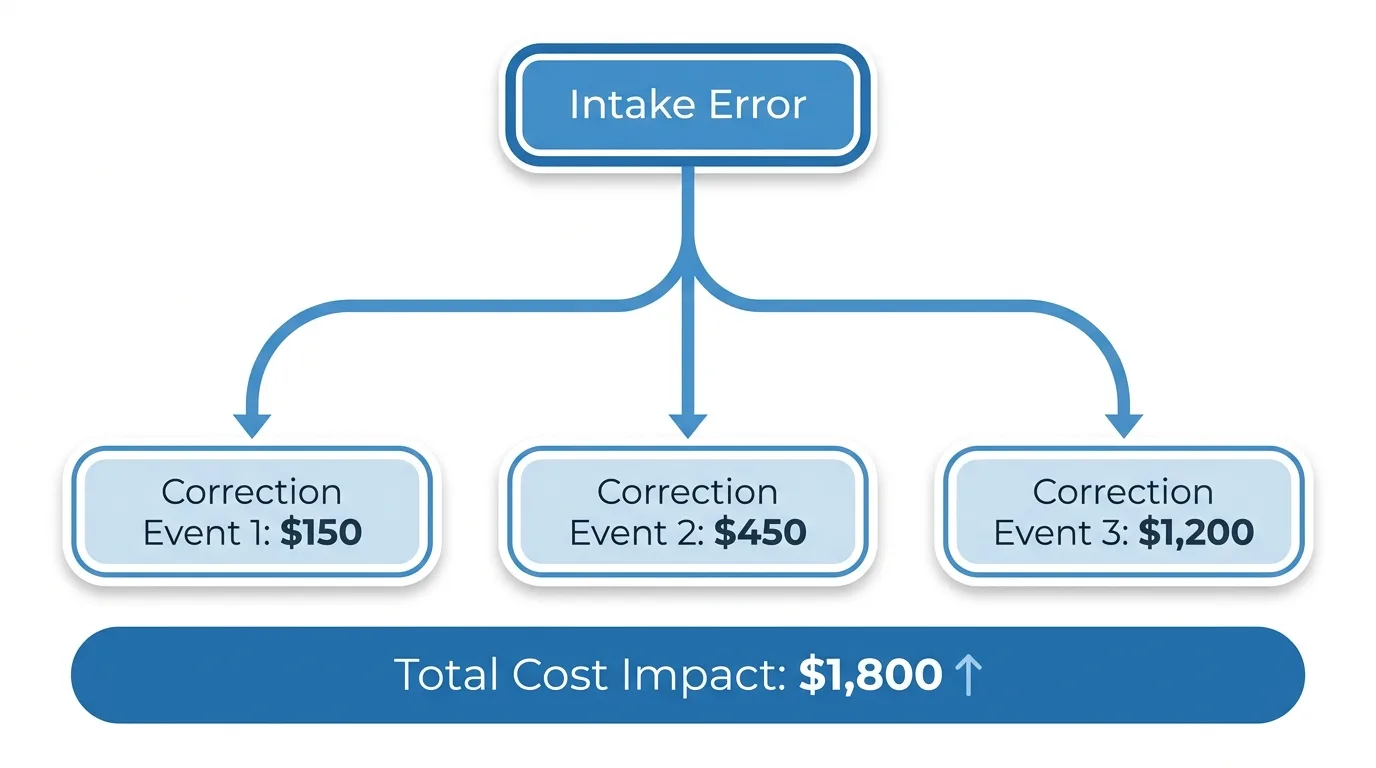
Technical schematic
Fig 1.1: The intake error cascade. A single missing or incorrect field at first contact propagates into an average of 3.4 downstream correction events, each at progressively higher cost. The total downstream cost of a single intake error averages $285 — against a prevention cost of near zero with automated validation.
What Voice AI Intake Actually Eliminates
Voice AI claimant intake does not simply make manual intake faster. It removes entire categories of cost from the process — and the distinction matters when building a business case.
It eliminates first-attempt call failures. An AI voice agent operates 24 hours a day, retries on no-answer, and reaches claimants at the time they are available rather than the time a coordinator's shift allows. Reachability on AI-driven outreach averages 78–85% versus 45–55% on manual first-attempt calls. That difference alone reduces re-contact labour by 40% and compresses intake cycle time from days to hours.
It eliminates transcription errors. Voice AI intake captures structured fields directly from conversation — there is no human transcription step, no judgment call about which field a piece of information belongs to, no abbreviation that only one coordinator understands. Data quality at intake improves to 97–99% field accuracy, eliminating the downstream correction events that currently consume 18–22% of all files.
It eliminates the coordinator bottleneck. Manual intake scales linearly with headcount — more referrals requires more staff. Voice AI intake scales horizontally without marginal cost. A practice that currently employs three intake coordinators can process double the referral volume with the same headcount once voice AI handles first-pass intake. The coordinators shift to exception handling: complex files, escalated cases, and relationship management with referral sources. That is a material upgrade in how their skills are deployed.

The Shift from Cost Centre to Competitive Advantage
Intake has always been treated as overhead — a necessary cost of doing business. Voice AI transforms it into a differentiator. The operations that reach claimants faster, capture cleaner data, and process files with less re-work are winning referral relationships on speed and reliability. Intake quality is now a competitive moat.
78–85%
First-contact reachability rate
99%
Structured field accuracy at capture
60%
Reduction in intake cycle time
2×
Referral capacity on same headcount
Making the Switch: Where to Start
The most common mistake operations make when evaluating AI intake is treating it as an all-or-nothing replacement. It is not. The highest-impact entry point is outbound confirmation calls — the most time-consuming and lowest-complexity part of the intake workflow. Deploying an AI agent to handle appointment confirmations, instruction delivery, and availability capture requires no integration with clinical systems and delivers measurable ROI within the first 30 days.
From there, the natural expansion is inbound intake: structured data capture from new referrals, replacing the manual parsing and entry workflow. This requires integration with your case management system, but most modern platforms expose APIs that make the connection straightforward. Once inbound intake is automated, the re-work and error-correction costs disappear almost entirely.
The final layer is exception-based coordination: routing complex files, managing escalations, and handling the cases that genuinely require human judgment. At this stage, your coordinators are doing the work they were hired for — not the work that keeps them too busy to do it well.
Manual claimant intake is a solved problem. The technology exists, the ROI is clear, and the operations that are moving now are building cost and quality advantages that will be very difficult for their competitors to close. The hidden cost of inaction is compounding, quarter by quarter, in the same way the hidden cost of manual intake has always compounded — quietly, persistently, and at scale.