
The Day a Case Opens Is the Day Everything Is Decided
In workers' compensation, the first 24 to 72 hours of a claim are disproportionately consequential. Studies consistently show that claims reported and actioned within 24 hours of injury resolve faster, cost less, and produce better outcomes for injured workers than those that sit unreported or unprocessed. Yet the intake process — the mechanism by which a claim actually enters the system — remains one of the most manual, fragmented, and error-prone parts of the entire case lifecycle.
An injured worker calls in. A coordinator answers if they are available — which, depending on volume and time of day, is not guaranteed. The coordinator asks a series of questions, types the responses into a system that was not designed for conversation, and creates a file that is already incomplete by the time it is saved. The worker hangs up uncertain about what happens next. The file sits in a queue. The 24-hour window closes.
This is not a failure of individual people. It is a failure of system design. Workers' compensation intake was built for a world where volume was manageable, data entry was the only option, and the cost of delay was invisible. None of those conditions hold today. Voice AI intake is the architectural correction that the sector has needed for twenty years.
The Five Pressure Points in Workers' Comp Intake
First contact failure is the most visible problem. An injured worker who cannot reach someone on the day of injury is a worker who delays reporting — sometimes by days, sometimes indefinitely. Every day of delay increases claim duration, medical costs, and the likelihood of legal representation. AI intake eliminates first contact failure by being available continuously, answering immediately, and conducting a structured intake without a hold queue.
Incomplete injury capture is the second. A coordinator conducting a first call collects what they can in the time available. Pain location, mechanism of injury, immediate medical treatment — these are captured if the questions are asked in the right order, and the worker can articulate the answers clearly. Pre-existing conditions, prior claims history, accommodation requirements, and preferred communication language are frequently missed. AI intake asks every required field, every time, and follows up on incomplete responses before the call ends.
Employer coordination is the third. Workers' comp intake requires parallel data from two parties — the worker and the employer — whose information must align for the claim to proceed cleanly. Discrepancies between reported injury date, reported mechanism, and employer incident records are one of the primary drivers of claim disputes. AI intake systems can initiate employer-side verification simultaneously with worker intake, flagging discrepancies for case manager review before the file is even formally opened.
Medical triage routing is the fourth. An injured worker who is directed to the wrong medical provider — a general practitioner when an occupational physician is required, a hospital when an urgent care clinic is appropriate — creates delays and cost overruns that ripple through the entire claim. AI intake systems configured with jurisdiction-specific medical triage logic can provide immediate, accurate direction to the appropriate provider based on injury type, severity indicators, and network availability.
Legal exposure at intake is the fifth and most underappreciated. A poorly documented intake creates ambiguity that legal representatives exploit. If an injured worker's reported symptoms at intake differ from what they report to a physician three days later, that discrepancy becomes a credibility issue. If the intake record is incomplete, the insurer cannot demonstrate what information the worker provided at first contact. AI intake produces a timestamped, verbatim, structured record of every exchange — a record that is legally defensible in a way that coordinator notes are not.
How Voice AI Intake Works in a Workers' Comp Context
When an injured worker contacts the intake system — by phone or secure web voice call — the voice AI agent identifies the case type and activates the appropriate intake protocol. For a workers' compensation first notice of loss, that protocol includes: employer identification, worker demographics, injury date and time, injury location on the employer's premises, mechanism of injury, body parts affected, immediate medical treatment sought, treating physician (if known), witness information, and any prior claims history.
The AI does not read these questions from a list. It conducts a conversation — confirming what the worker says, probing when responses are ambiguous, and adapting the sequence when the worker volunteers information out of order. If the worker reports that they have already visited a physician, the system captures the provider details before returning to the outstanding fields. If the worker is distressed or in pain, the system paces itself and acknowledges the difficulty without losing the thread of the structured intake.
At the end of the call, the worker receives an immediate confirmation — by voice, SMS, or email — that their claim has been received, their reference number, and what happens next. The case file, fully structured and validated, is written to the claims management system. The case manager who opens that file the next morning does not receive a voice recording to transcribe. They receive a complete, structured, ready-to-action intake record.
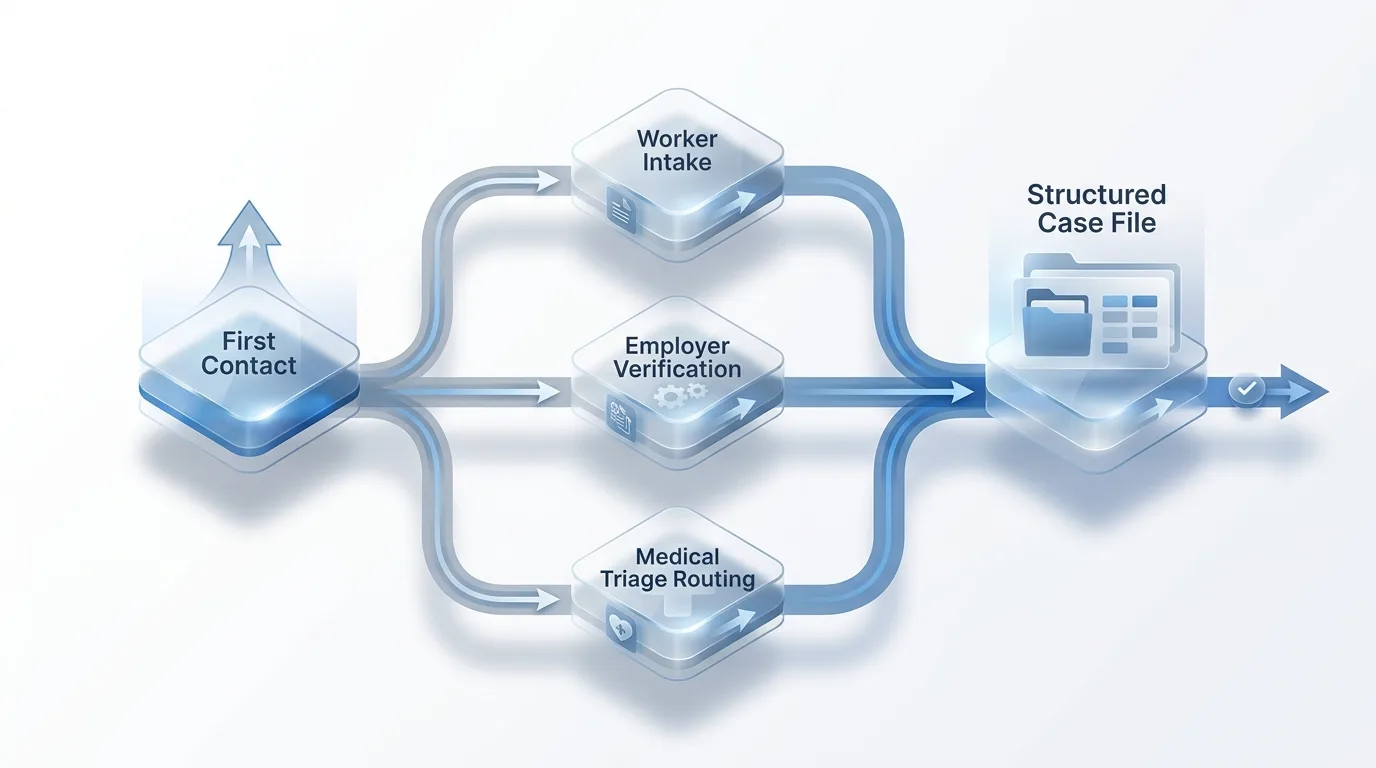
Technical schematic
Fig 1.1: The AI-powered workers' comp intake workflow. First contact triggers simultaneous worker intake, employer verification, and medical triage routing — all within a single structured session. The case manager receives a complete, validated file, not a raw transcript.
Speed as a Clinical Outcome
The business case for voice AI workers' comp intake is usually framed in terms of cost reduction and operational efficiency. Those benefits are real and measurable. But there is a more important argument that gets less attention: speed of intake is a clinical outcome.
An injured worker who receives appropriate medical direction within two hours of injury has a materially different recovery trajectory than one who waits two days. Musculoskeletal injuries — the most common workers' comp claim type — respond significantly better to early intervention. Delays in the first 72 hours are associated with higher rates of chronification, increased opioid prescription rates, and longer disability durations. These are not marginal differences. They represent significant differences in human outcomes and claim costs simultaneously.
AI intake eliminates the structural delays that the manual process creates. No hold queue. No callback that never comes. No coordinator who is on another call when the injured worker calls in from the worksite parking lot, trying to understand what to do next. Immediate, structured, accurate intake is not just an efficiency gain — it is the clinical intervention that sets the recovery trajectory.
The workers' compensation sector has spent decades optimising the clinical and legal dimensions of case management while leaving the intake process largely unchanged. AI-powered intake closes that gap — and it does so in a way that improves outcomes for injured workers, reduces costs for insurers, and creates defensible records for everyone involved. That convergence of interests is rare in this sector. It is worth acting on.
Jurisdiction, Compliance, and Configuration
Workers' compensation is not a single system. It is fifty-plus systems in North America alone, each with distinct reporting requirements, time limits, medical provider networks, and documentation standards. An AI intake system that works for a California workers' comp claim may not satisfy the first notice of loss requirements for a New York claim. Configuration is not optional — it is the product.
Purpose-built workers' comp AI intake systems are configured at the jurisdiction level: the required fields for first notice of loss, the timeframe for employer notification, the approved medical provider network logic, the documentation standards that will satisfy the relevant workers' compensation board. When a claim is filed through the system, the intake protocol reflects those requirements — not a generic template that a case manager must later correct.
This jurisdictional precision also matters for compliance exposure. Workers' compensation boards have specific requirements for how first notice of loss must be documented. An AI system that captures and timestamps every exchange, validates required fields in real time, and writes a structured record to the claims system creates a compliance posture that manual intake simply cannot match. The question for case management organisations is not whether AI intake meets the compliance bar — it is whether their current manual process does.

What Voice AI Intake Delivers Across the Workers' Comp Lifecycle
Organisations that have deployed AI-powered intake for workers' compensation report consistent improvements across speed, completeness, compliance, and clinical outcomes — while reducing administrative burden on case management staff.
<2 hrs
Average time from injury to filed claim
98%
First-call intake completion rate
45%
Reduction in claim duration (early intake)
30%
Lower average claim cost vs manual intake