
Stop Estimating. Start Calculating.
The problem with most ROI discussions in enterprise software is that they are built on assumptions that benefit the vendor and crumble under scrutiny. Percentage improvements are cited without baselines. Cost savings are claimed without cost models. Productivity gains are projected without explaining the mechanism. By the time a sceptical CFO finishes asking questions, the ROI case is held together with narrative rather than numbers.
This article is different. We are going to build the ROI model for voice AI intake automation from first principles — with real cost structures, real productivity assumptions, and real performance benchmarks drawn from operational deployments. We will show the inputs, explain the methodology, and arrive at a number you can defend in a budget meeting.
The model is built for a mid-size insurance, IME, or claims operation processing 100 intake contacts per week. If your volume is different, the math scales linearly. If your cost structure is different, the inputs are clearly labelled for substitution. The point is not to give you a number to copy — it is to give you a model you can make your own.
Step One: Quantify the Current State Cost
Before you can calculate a return, you need an honest baseline. Most operations underestimate their current intake cost because they only count the obvious line items. The complete cost model has five components.
Component one: coordinator labour. A team of three intake coordinators at a fully-loaded cost of $82,000 each — salary, benefits, payroll tax, paid leave, and supervisory overhead — represents $246,000 annually. This is the number most operations start with. It is not the number they should end with.
Component two: re-work and error correction. Industry data for manual intake operations shows that 18–22% of intake records contain errors requiring correction. At 100 weekly contacts and an average correction time of 11 minutes per event, that is 18–22 correction events per week — roughly 3.5 hours of coordinator time. Annualised at the fully-loaded rate: $14,900. Add the downstream cost of errors that propagate before detection — rescheduling, re-examination, compliance corrections — and the real cost is closer to $28,000 annually.
Component three: no-shows driven by inadequate confirmation. A 15% no-show rate on 100 weekly contacts — 15 missed appointments — at a direct cost of $220 per missed slot (physician time, facility, re-coordination) is $3,300 per week, or $171,600 annually. This is the number that genuinely shocks most operations leaders, because it has always been treated as an inevitable cost of doing business rather than a solvable operational problem.
Component four: opportunity cost of missed after-hours contacts. An operation with business-hours-only intake misses an estimated 12–18% of initial contact attempts that occur outside those hours. For 100 weekly contacts, that is 12–18 claimants per week who experience delay, some of whom resolve their claims through competing providers or generate complaints. Quantifying this conservatively — assuming only 20% of missed after-hours contacts result in a materially worse outcome — represents $18,000–$26,000 in annual value at risk.
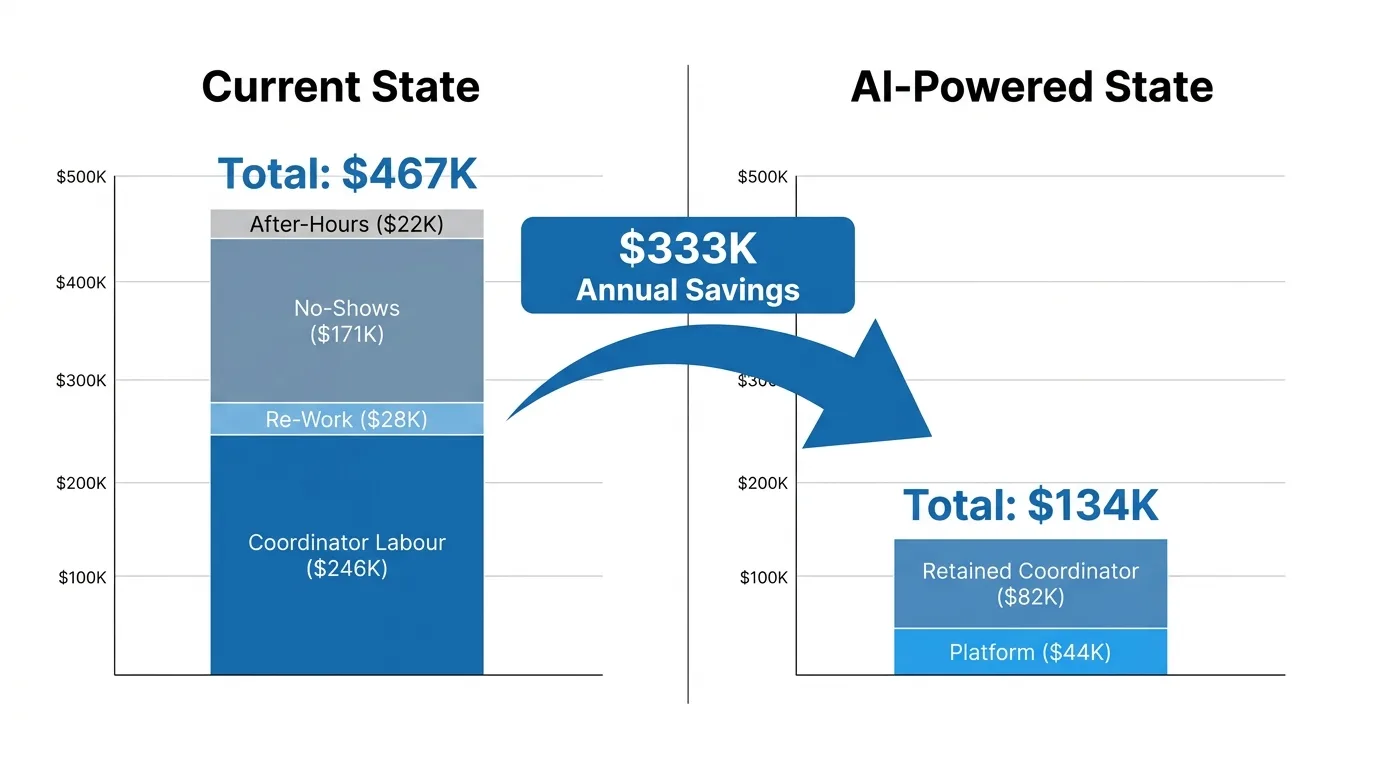
The honest current-state cost for a 100-contact-per-week operation: $246,000 in coordinator labour + $28,000 in error and re-work costs + $171,600 in no-show costs + $22,000 in after-hours opportunity cost. Total: $467,600 annually. That is the baseline against which AI intake ROI must be measured.
Step Two: Model the Voice AI State
Voice AI intake for a 100-contact-per-week operation has three cost components. Platform and configuration: a purpose-configured voice AI intake system, including integration with your case management platform and ongoing protocol maintenance, costs approximately $36,000 to $52,000 annually at this volume. This includes the technology, the configuration work, and the support required to keep the system current as your assessment menu and jurisdictional requirements evolve.
Retained human coordination: AI intake handles 85% of contacts autonomously. The remaining 15% — complex cases, distressed claimants, escalations — require human judgment. One experienced coordinator operating in an exception-management and quality-oversight role, at a fully-loaded cost of $82,000, is sufficient for a 100-contact-per-week operation. The coordinator team shrinks from three to one, but the one who remains is doing higher-value work with better outcomes.
Transition and change management: a one-time cost of $8,000–$14,000 for the implementation phase — system configuration, staff training, protocol development, and the calibration period during which the system is refined against real intake data. This is the cost that is most commonly underestimated and most consequential to get right. A poorly configured AI system produces poor results. Budget for configuration, not just deployment.
Total AI-powered state annual cost: $36,000–$52,000 (platform) + $82,000 (retained coordinator) = $118,000–$134,000 annually, plus a one-time implementation cost of $8,000–$14,000.
Step Three: Calculate the Return
The annual savings from switching to voice AI intake is the difference between the current-state cost and the voice AI state cost: $467,600 minus $134,000 equals $333,600 in annual savings at the high end of the AI cost range. Against a one-time implementation cost of $14,000, the payback period is 15 days.
That number is not a typo. The payback period for AI intake automation, modelled conservatively, is measured in weeks rather than years. The reason is that the no-show cost component — $171,600 annually — begins reducing immediately upon deployment, and it reduces significantly. AI-driven outreach and confirmation consistently reduces no-show rates by 25–35%. A 30% reduction alone saves $51,480 annually, exceeding the implementation cost in the first month.
The three-year net value — annual savings minus platform costs, with implementation cost amortised in year one — is approximately $880,000 to $960,000 for a 100-contact-per-week operation. The three-year ROI, calculated as net value divided by total investment, is 620–680%. These are not projections built on optimistic assumptions. They are the output of a conservative model with real cost inputs and performance benchmarks drawn from operational deployments.
Technical schematic
Fig 1.1: Three-year ROI model for a 100-contact-per-week intake operation. Current-state cost of $467,600 annually versus AI-powered state cost of $134,000 — producing $333,600 in annual savings and a 15-day payback period against a $14,000 implementation investment.
The Variables That Move the Number Most
Not every operation will see exactly these numbers. Three variables move the ROI calculation most significantly, and understanding them helps you calibrate the model for your specific situation.
No-show rate is the most powerful variable. Operations with higher-than-average no-show rates — common in workers' compensation and disability assessment panels — see disproportionate ROI from AI intake because the confirmation improvement is so material. Every percentage point reduction in no-show rate on a 100-contact-per-week operation is worth approximately $11,440 annually. An operation starting from a 20% no-show rate and reaching 12% through AI-driven confirmation captures $91,520 in annual savings from that factor alone.
Current coordinator team size relative to volume is the second variable. Operations that are understaffed relative to intake volume — where coordinators are stretched thin and quality has already degraded — see faster ROI because the AI immediately provides coverage that the human team cannot. Operations that are well-staffed with experienced coordinators see slower but still compelling ROI, primarily from quality and consistency improvements rather than pure labour reduction.
Intake complexity is the third variable. Operations with highly standardised intake protocols — routine FNOL reporting, standard IME scheduling, predictable assessment types — see higher AI containment rates and therefore higher ROI. Operations with highly variable intake — complex multi-jurisdiction claims, unusual assessment types, high proportions of non-English speakers — require more configuration investment and see slightly lower containment rates, but still achieve strongly positive ROI.
Beyond the Spreadsheet: The Value That Does Not Model Easily
The model above captures the quantifiable return. There is a second category of value from AI intake automation that does not fit neatly into a spreadsheet but is real and operationally significant.
Scalability without friction is the first. A human intake team that handles 100 contacts per week requires meaningful investment to scale to 200: recruitment, training, desk space, supervisory expansion. An AI intake system scales to 200 contacts per week with a configuration update and a modest increase in platform cost. For practices in growth mode — or practices facing referral volume spikes during litigation cycles, seasonal peaks, or new client onboarding — this elasticity has value that the steady-state ROI model does not capture.
Competitive positioning is the second. Referral sources choose providers partly on operational reliability: who answers when called, who processes files quickly, who delivers reports on time. An operation running AI intake answers every call immediately, processes every referral the same day it arrives, and produces complete pre-examination files consistently. That operational reliability is a competitive differentiator that generates referral source loyalty and, over time, volume growth. The revenue impact of that growth does not appear in a cost-reduction ROI model — but it is the most durable return on the investment.
Data quality compounding is the third. Every structured intake record produced by AI is clean, complete, and consistent. Over time, that data becomes an asset: patterns in referral volume, claimant demographics, no-show predictors, and assessment type mix become visible in ways that manual intake records never enable. Operations that have deployed AI intake for two or more years report using their intake data to optimise scheduling, anticipate staffing needs, and identify referral source opportunities. The analytical value of clean data is a return that accrues silently and compounds every month.
The ROI of voice AI intake automation is not a belief system. It is a calculation. Build the model with your numbers, apply conservative assumptions, and the result is the same for every operation above a threshold of meaningful intake volume: the return is large, the payback is fast, and the competitive cost of inaction compounds every quarter that a decision is deferred.

The ROI Summary for a 100-Contact/Week Operation
Conservative model, real cost inputs, operational performance benchmarks. The numbers are reproducible — substitute your cost structure and volume to generate your specific return.
$333,600
Annual savings at 100 contacts/week
15 days
Payback period on implementation cost
650%
Three-year ROI (net value / total investment)
$960K
Three-year net value, conservative model