
The Question Nobody Wants to Ask Out Loud
There is an uncomfortable conversation happening quietly in insurance and healthcare operations across the industry. It is happening in budget meetings, in vendor evaluations, in one-on-ones between operations directors and their teams. The question at the centre of it is simple, and everyone already knows the answer: can an AI voice agent conduct an intake call better than a human coordinator — and if so, what does that mean for the people currently doing that job?
The discomfort is understandable. Intake coordinators are skilled professionals who do work that genuinely matters. They de-escalate distressed claimants, navigate complex claim histories, and bring institutional knowledge to files that a system cannot easily replicate. Framing this as a simple "AI vs human" competition misses the real operational question, which is: what are your coordinators actually spending most of their time doing, and is that the best use of their capabilities?
The data, when you look at it honestly, is clarifying. The majority of intake coordinator time — typically 60 to 75 percent of it — is spent on tasks that are fundamentally mechanical: dialling numbers, waiting for answers, asking scripted questions, typing responses into systems, re-calling when nobody answered, correcting data entry errors, and coordinating handoffs. That is not the work that requires human judgment. It is the work that happens to have been done by humans because there was no alternative. Now there is.
The Real Cost of a Human Intake Coordinator
Building an honest cost comparison requires starting with an honest cost model. The salary of an intake coordinator is the visible number — typically $38,000 to $52,000 annually in North American insurance and healthcare operations. But the fully-loaded cost is substantially higher. Add employer payroll taxes (7–8%), health benefits ($8,000–$14,000), paid time off (15–20 days), training and onboarding for a role with 18-month average tenure, supervisory overhead, and the infrastructure cost of the desk, phone system, and software licences they use.
The real fully-loaded annual cost of an intake coordinator is typically $68,000 to $95,000. For a team of five, that is $340,000 to $475,000 annually — before accounting for the cost of errors, re-work, and the intake volume the team cannot handle during peak periods or staff absence.
There is also a capacity ceiling that no amount of budget can fix. A coordinator can conduct, at peak, 20 to 28 structured intake calls per day before quality degrades. They work 8 hours, 5 days a week. They do not work evenings, weekends, or public holidays — which is precisely when injured workers and claimants most need to report. Every after-hours claim that goes unprocessed until the next business day is a day of delay that the best coordinator in the world cannot recover.
The Real Cost of an AI Voice Intake System
Voice AI intake pricing varies by provider and deployment model, but the structure is consistent: a platform cost covering configuration, integration, and ongoing maintenance, plus a per-interaction or per-minute usage cost. For a mid-size operation processing 80 to 150 intake contacts per week, total voice AI intake costs typically fall in the range of $24,000 to $48,000 annually — inclusive of the platform, integration, and ongoing configuration support.
That per-interaction cost does not increase when volume doubles. It does not require recruitment when a team member resigns. It does not degrade at 4pm on a Friday afternoon or fail to answer at 7pm on a Sunday when a worker is calling from an urgent care waiting room. The cost model is fundamentally different: it scales with usage rather than headcount, and the marginal cost of each additional intake call approaches zero as volume grows.
The honest caveat is that AI intake is not free to implement well. Configuration requires time and expertise. Integration with case management systems requires technical work. The intake protocols must be built to reflect the specific assessment types, jurisdictional requirements, and clinical standards of the practice. Done poorly, AI intake produces worse results than human intake. Done well — configured specifically, tested rigorously, and maintained actively — it produces consistently better results at lower cost.
Head to Head: Where Each Performs Better
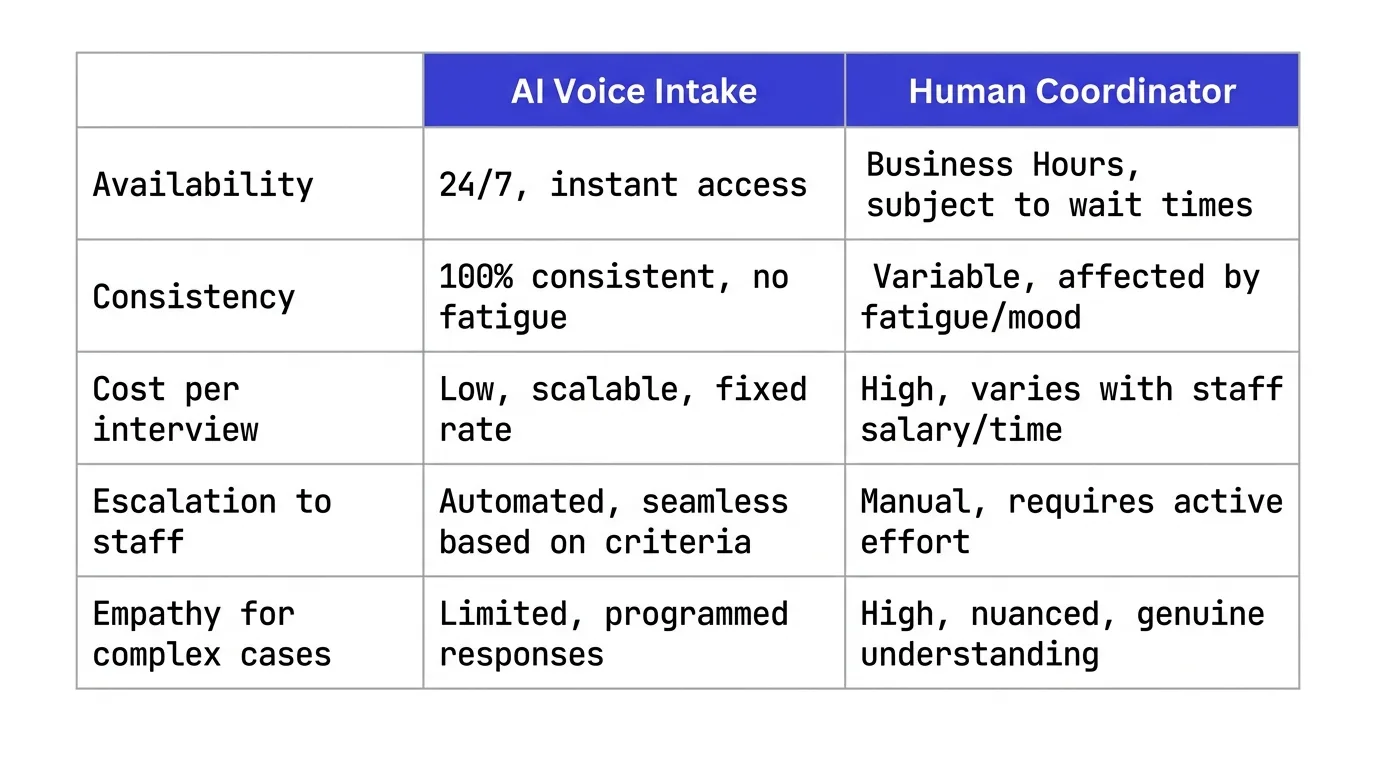
Voice AI intake outperforms human coordinators on five dimensions without exception. Availability: voice AI answers every call immediately, 24 hours a day, 365 days a year. Consistency: every required field is asked, every time, with no variation based on coordinator fatigue or caseload. Throughput: voice AI handles unlimited simultaneous calls without queue formation or hold times. Data quality: structured capture with real-time validation produces 97–99% field accuracy versus 78–85% for manual entry. Cost per intake: at scale, voice AI intake costs 60–75% less per completed intake than a fully-loaded human coordinator.
Human coordinators outperform AI in three areas that matter differently depending on the case type. Complex emotional navigation: a claimant who is acutely distressed, in crisis, or presenting with significant mental health indicators needs a human in the conversation. Experienced coordinators de-escalate situations that AI systems should not attempt to handle autonomously. Ambiguous clinical judgment: when a claimant presents an injury history that does not map to standard assessment categories, an experienced coordinator applies contextual judgment that current AI systems cannot fully replicate. Relationship management: referral source relationships are built on human interaction. Senior coordinators who manage key accounts provide value that no AI system currently substitutes.
The operational conclusion that most practices reach when they map these capabilities against their actual workflow is that the areas where humans genuinely outperform AI represent a small fraction of total intake volume — typically 8 to 15 percent of contacts. The other 85 to 92 percent are structured, predictable, and well within AI capability. The question is not whether to replace coordinators. It is whether to redeploy them toward the work where they add value that AI cannot.
Technical schematic
Fig 1.1: Performance comparison across eight dimensions. AI intake leads on availability, consistency, throughput, data quality, and cost. Human coordinators lead on emotional navigation, ambiguous clinical judgment, and relationship management. The 85/15 split determines where each should operate.
The Redeployment Dividend
The organisations that get voice AI intake wrong treat it as a cost-cutting exercise: deploy AI, reduce headcount, book the savings. The organisations that get it right treat it as a capability expansion: deploy voice AI on the mechanical work, redeploy coordinators on the work that machines cannot do, and end up with both lower costs and better outputs.
What does redeployment look like in practice? A coordinator who previously spent six hours a day on outbound confirmation calls now spends that time on complex case management: reviewing AI-flagged discrepancies, managing escalated claimants, building relationships with high-volume referral sources, and conducting the small percentage of intake calls that genuinely require human judgment. Their job becomes more interesting, more skilled, and more valuable to the organisation. Retention improves. Institutional knowledge deepens rather than cycling out every 18 months.
The practices that have made this transition report a consistent pattern: the coordinators who were most anxious about AI displacement are, twelve months later, the most enthusiastic advocates for the system. Not because they do not understand that AI changed their role, but because the role it changed them into is one they prefer. The work that made the job frustrating — the hold queues, the data entry, the tenth confirmation call of the morning — is gone. The work that made the job meaningful — the complex cases, the distressed claimants who needed a human voice, the referral relationships built on trust — is all that remains.
The Numbers That Drive the Decision
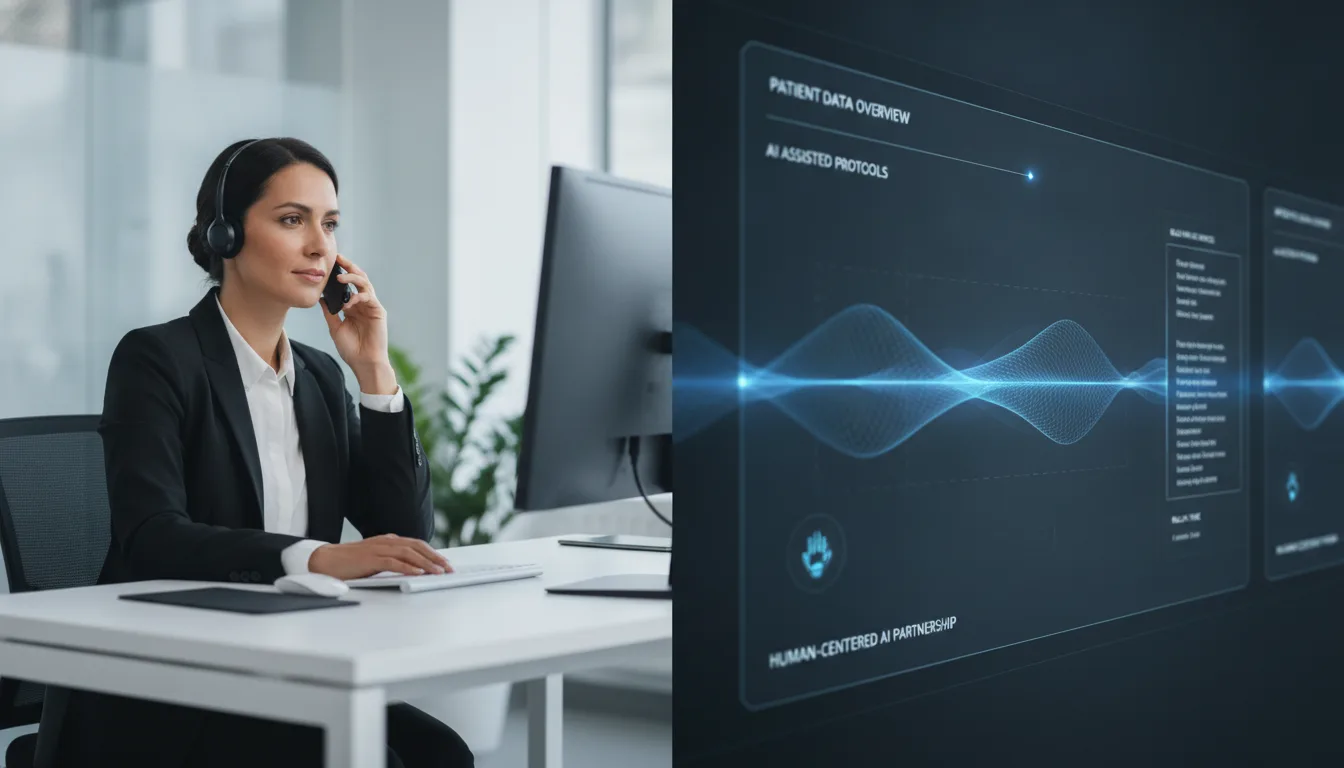
For a mid-size operation processing 100 weekly intake contacts, the cost and performance gap between AI-powered and human-only intake compounds significantly over a three-year horizon. The case for a hybrid model — AI on mechanical intake, humans on complex cases — is the strongest of all.
65%
Lower cost per completed intake at scale
24/7
Availability vs 8hrs/5 days for human teams
99%
AI field accuracy vs 82% manual average
85%
Of intake volume suitable for AI handling
Making the Transition Without Making Enemies
The operational case for AI intake is clear. The human case — how you introduce it, communicate it, and manage the transition for the people whose roles it changes — is where most implementations succeed or fail.
The practices with the smoothest transitions share a common approach. They involve coordinators in the configuration process from the start: their knowledge of what goes wrong in manual intake shapes the AI protocols that replace it. They are transparent about what is changing and honest that some roles will evolve significantly. They identify early which coordinators are best suited for the complex case management work that AI cannot do, and they create a credible path for those people to move into it.
They also set realistic expectations about the transition period. The first four to eight weeks of AI intake deployment are a calibration phase — the system learns the edge cases, the configuration is refined, and coordinators develop confidence in what the AI produces. Treating this phase as failure rather than process is the most common mistake. The organisations that sustain through it reliably reach a steady state where the AI handles the volume, the coordinators handle the exceptions, and the practice operates with a structural cost and quality advantage that compounds every quarter.
Voice AI and human coordinators are not in competition. They are in sequence. The question is not which one wins — it is how quickly your operation reaches the configuration where each is doing the work it does best.