
The Invisible Gap Between Intake and Examination
Ask any IME medical director what they wish they had before walking into an examination, and the answer is consistent: a complete file. Not a partial referral document. Not coordinator notes written in abbreviations only one person understands. Not a claimant history that stops at the injury date and ignores the four years of prior treatment that preceded it. A complete, structured, physician-ready record that tells the full clinical story before the first question is asked.
That gap — between what the intake process captures and what a physician actually needs to conduct a rigorous examination — is one of the most expensive and underexamined problems in the IME sector. It drives examination delays, generates requests for additional information, produces reports that require revision, and erodes the referral source confidence that IME practices depend on for growth.
The traditional answer to this problem has been to put more skilled staff at the intake stage — more experienced coordinators, more thorough intake forms, more follow-up calls to fill missing fields. The problem with that answer is that it scales with headcount, not with quality. More calls does not mean better data. It means more time spent on the same limited return. Voice AI intake changes the equation entirely: not more effort, but a different architecture.
What a Physician Actually Needs Before an IME
The physician-ready file is not the same as the intake record. The intake record captures what the claimant reported. The physician-ready file integrates that with what the referral source provided, what the clinical records show, and what the assessment type requires — structured into a format the physician can absorb in the seven minutes before the examination begins.
For a standard workers' compensation IME, the physician needs: the mechanism of injury with biomechanical detail, the full treatment history including provider names and dates, current reported symptoms with functional impact, prior claims or pre-existing conditions that may be relevant, the specific questions the referral source wants addressed, and the jurisdiction-specific assessment framework the report must conform to.
For a psychological IME or disability evaluation, the requirements expand significantly: psychiatric history, medication history with dosage and duration, functional capacity in daily living activities, social and occupational history, and any prior psychological assessments with their conclusions. A physician who walks in without this information spends the first fifteen to twenty minutes of a scheduled examination reconstructing it — time that is billed, time that is wasted, and time that the claimant experiences as a disorganised process that undermines their confidence in the outcome.
The question is not whether physicians need complete pre-examination files. They do, and the sector knows it. The question is whether the intake and pre-examination workflow is capable of producing them. For most IME practices operating on manual processes, the honest answer is: not consistently.
The New Workflow: How Voice AI Bridges Intake and Clinical Preparation
The voice AI IME workflow begins at referral receipt, not at the intake call. When a referral arrives — by email, portal, or integrated system — the system parses the document, extracts structured fields, and immediately identifies what is missing. If the referral specifies a psychiatric assessment but contains no prior mental health history, the system flags the gap and initiates a records request to the referral source before a coordinator has reviewed the file. That single automation step eliminates one of the most common causes of examination delay: discovering missing records on the day of the appointment.
The voice intake call itself — when Aeris contacts the claimant by phone or web call — is designed not as a data collection exercise but as a clinical preparation interview. The questions are sequenced to build a coherent clinical picture: from the index injury or condition, through treatment history, to current functional status and any factors that may affect the examination. The voice AI adapts in real time: if the claimant mentions a treating specialist not referenced in the referral, the system captures that detail and flags it for records retrieval. If the claimant reports limitations that exceed what the referral documentation suggests, the system notes the discrepancy for physician review.
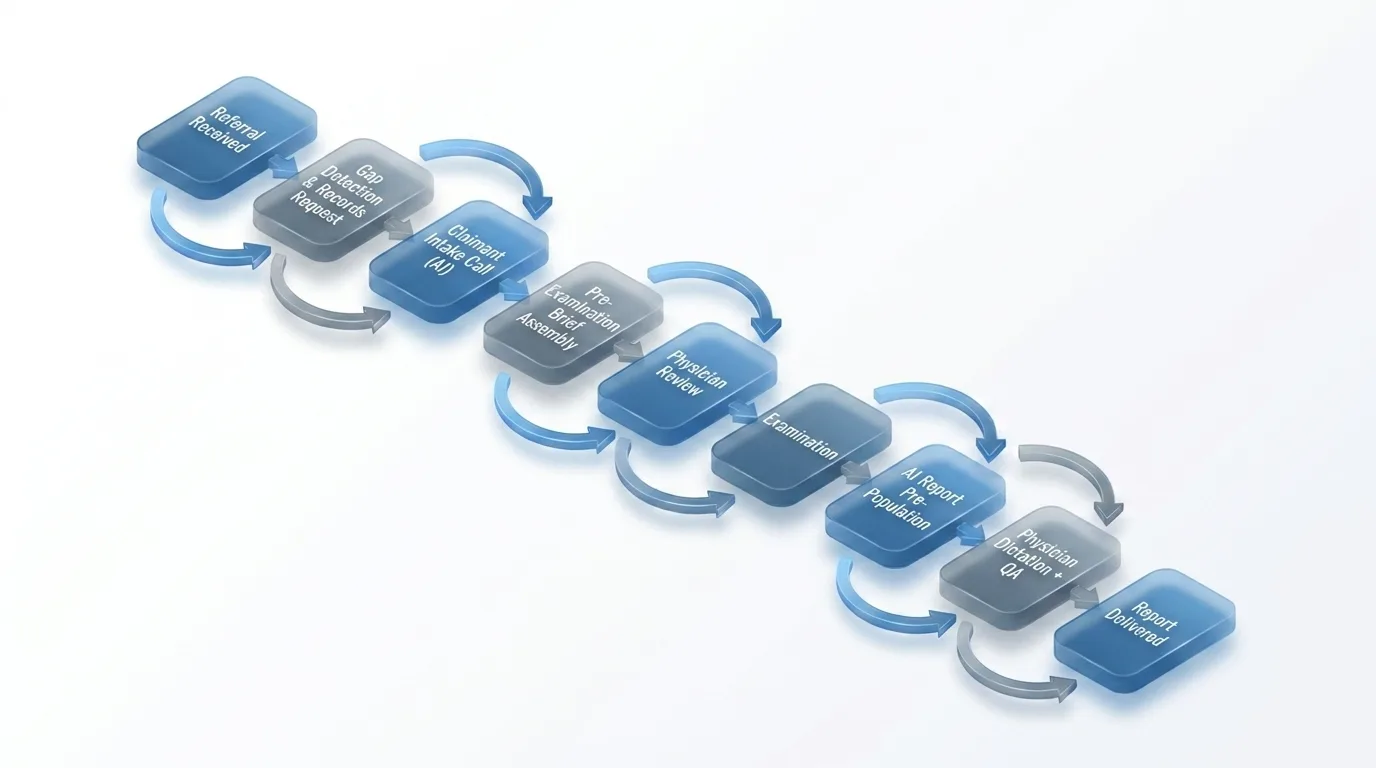
When the claimant intake is complete, the AI initiates the pre-examination build: pulling the structured intake data, the referral fields, any retrieved clinical records summaries, and the assessment-type template into a single pre-examination brief. That brief is generated automatically, reviewed by a coordinator for quality, and delivered to the examining physician at least 24 hours before the appointment. No assembly required. No missing pages. No last-minute calls from the physician's office asking for records that should have been there from the start.
Technical schematic
Fig 1.1: The AI-powered IME workflow. From the moment a referral is received, the system runs gap detection, initiates records requests, conducts claimant intake, and assembles the pre-examination brief — automatically, in parallel, without coordinator involvement until the quality review step.
The Report That Writes Itself — Almost
The examination is complete. The physician has conducted a rigorous assessment, taken their own notes, and dictated their clinical observations. In the traditional workflow, those dictations go to a transcription service, come back three to five days later as a raw transcript, and then require a report editor to structure them into the format the referral source expects — jurisdiction-specific, question-by-question, with citations to the clinical record and the intake history.
In the AI-powered workflow, the report generation step is partly automated. Because the intake data is already structured, the clinical record references are already indexed, and the referral source questions are already identified, the AI can pre-populate the report framework before the physician's dictation is even transcribed. The structure is built. The citations are placed. The jurisdiction-specific format is applied. When the dictation arrives, it is slotted into a document that is already seventy percent complete.
Physicians who have worked with AI-assisted report generation consistently report the same experience: the first time feels strange, because the document already knows more than they expect. By the third case, it feels indispensable. Report turnaround that previously took eight to twelve days compresses to three to five. The bottleneck moves from report production to physician review — which is exactly where it should be, because that is the step that requires clinical judgment.
What This Means for Referral Source Relationships
Referral sources — insurers, employers, legal firms, case managers — choose IME providers on two criteria above all others: turnaround time and report quality. Both are directly determined by the efficiency and accuracy of the intake-to-report workflow. Practices that deliver complete, well-structured reports in five days will always beat practices that deliver incomplete reports in ten, regardless of physician credentials.
Voice AI intake changes the competitive position of a practice not by improving the clinical product — the physician's expertise is unchanged — but by removing the operational friction that delays and degrades the delivery of that product. When every claimant arrives well-prepared, when every physician walks in with a complete brief, and when every report is generated against a structured data foundation, the output is consistently better. Referral sources notice. Repeat business follows.
There is also a transparency benefit that tends to go underappreciated. AI-powered workflows produce audit trails that manual processes cannot. Every step from referral receipt to report delivery is logged, timestamped, and reviewable. When a referral source asks why a report took nine days instead of five, the practice can show exactly where the delay occurred — a late records response from a treating physician, a claimant who required three contact attempts, a revision request from counsel. That transparency builds trust in a sector where trust is built slowly and lost quickly.
The IME sector is not short of smart people working hard to deliver good clinical products. What it has historically lacked is an operational infrastructure capable of supporting those products at the pace and quality the market demands. AI-powered intake and workflow automation provides that infrastructure. The practices that adopt it earliest will not just be more efficient — they will be structurally more competitive than those that do not.

The Numbers Behind the New IME Workflow
Practices that have deployed AI-powered intake and report generation across their IME workflow report measurable gains across every stage of the lifecycle — from referral receipt to report delivery.
70%
Report pre-populated before dictation arrives
5 days
Average report turnaround vs 10-day baseline
95%
Pre-examination brief completeness rate
50%
Reduction in post-examination re-contact